
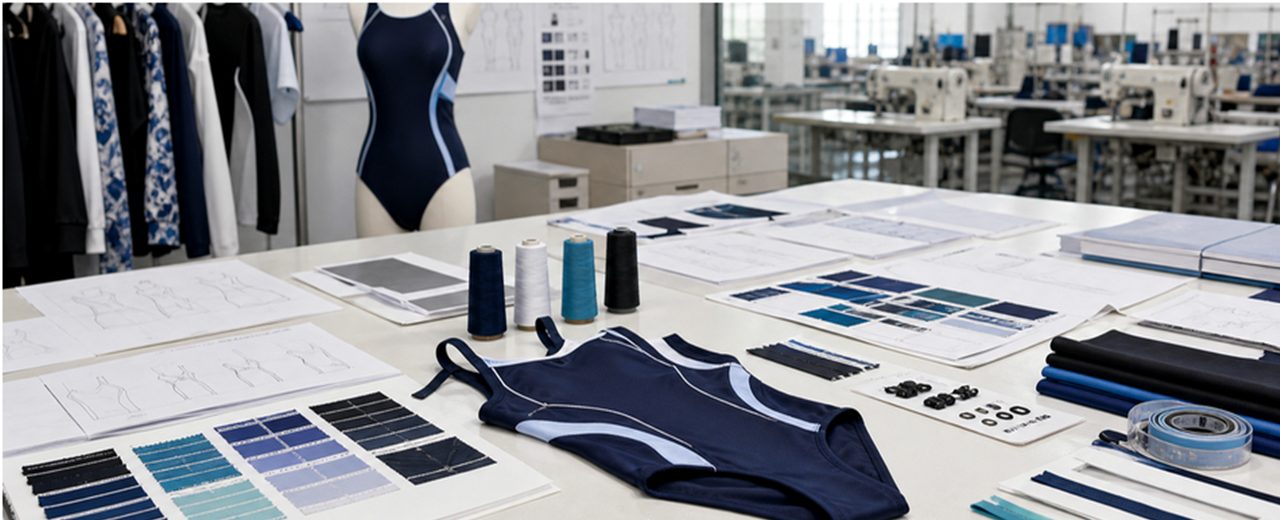
Why an Approved Swimwear Sample Can Still Fail in Bulk Production

The sample arrives, and everything appears to be on track.
The color is right. The fit has been approved. The straps sit correctly, the leg openings feel secure, and the lining provides enough coverage. Photography is booked, product pages are being prepared, and the launch date may already be fixed.
Then bulk production arrives.
The style is technically the same, but the result feels different. The bulk shade appears flatter or slightly different from the approved sample. A light-colored panel becomes more transparent when wet. Some leg openings feel tighter, while others no longer recover closely enough against the body.
For a brand, this is not simply a small manufacturing variation. It can delay a launch, disrupt a team delivery, increase inspection and rework costs, and weaken confidence in the next reorder.
In Brief
An approved swimwear sample confirms that one garment can be made successfully. Stable bulk production requires the fabric, pattern, lining, elastic tension, sewing method and inspection standard to work together repeatedly across an entire production run.
That difference is where many swimwear programs begin to lose control.
A Good Sample Is Not Yet a Production System
A development sample is usually made under favorable conditions. It requires only a small amount of fabric. The cutter can avoid an inconsistent section, and an experienced sample machinist can spend additional time adjusting the straps, binding or leg openings. If one area does not sit correctly, it can be removed and sewn again.
Bulk production works differently. Fabric is consumed by roll and dye lot. Multiple operators may work on the same style, while cutting, elastic application, sewing and finishing must follow repeatable standards rather than individual judgment.
This does not make the approved sample unreliable. It means sample approval must be translated into production data before the order is scaled.
The sample proves the product is possible. The production system proves it is repeatable.
The Same Fabric Specification Does Not Guarantee the Same Fit
Two swimwear fabrics may show similar compositions and weights on a specification sheet but behave differently in the finished garment. Knitting density, yarn construction, stretch direction, recovery, surface finish and heat-setting conditions can all affect fit and performance.
These differences may be difficult to see when the fabric is lying flat. They become clearer when the garment is stretched around the body:
· Straps may extend more than expected.
· Leg openings may feel restrictive or lose contact with the body.
· Lining may reduce the stretch of the outer fabric.
· Light colors may provide insufficient coverage when wet.
· The garment may not recover properly after repeated wear.
At SABOLAY, fabric is not selected after the style is confirmed. It is evaluated together with the intended use, pattern tension, construction and expected wearing frequency.
Our 280gsm training route—70% polyester and 30% LYCRA® XTRA LIFE™—is developed for dense coverage, strong compression and frequent use. If it is applied to a pattern originally developed for a conventional 200gsm fabric, the negative ease and elastic ratios may need adjustment.
Our 175gsm PBT route—53% polyester and 47% PBT—is designed for chlorine-resistant training, swim schools and team programs. Because it does not rely on conventional elastane, its stretch, hand feel and recovery must also be considered during pattern development.
Neither fabric is automatically better. They solve different problems.
Changing the fabric changes how tension moves through the entire swimsuit.
Where Bulk Production Differences Usually Begin
Most consistency problems are not caused by one dramatic mistake. They develop when several small differences appear at the same time: a new dye lot, a slightly different usable width, increased cutting tension, a change in elastic application, or a lining that restricts stretch more than expected.
Each variable may look acceptable on its own. Combined in a close-fitting swimsuit, they can create a noticeably different result. This is why final inspection alone is too late.
1. Recheck the Bulk Fabric
Compare bulk fabric with the approved material for shade, usable width, weight, stretch direction and recovery. For light-colored and high-coverage styles, evaluate wet opacity. Color-blocked products may also require checks for shade compatibility and migration risk.
2. Confirm with Actual Production Materials
A sample made with substitute fabric, temporary lining or a different elastic can confirm appearance, but not complete production performance. When a key material changes, review the pattern, tension and construction again.
3. Use the Pre-Production Sample to Test Repeatability
A pre-production sample should use the intended bulk fabric, trims, approved pattern and production sewing method. Its purpose is not to create another showroom sample. It is to confirm that the product can be reproduced under real production conditions. New fabrics, bonded structures and higher-risk constructions may also require a pilot run before full cutting.
How SABOLAY Approaches Sample Approval
At SABOLAY, sample approval is not the end of development. It is the point at which production conditions begin to be locked. Depending on the product, we evaluate fabric suitability, pattern negative ease, lining interaction, tension at straps and openings, construction repeatability and the material data that must be checked again when a new lot arrives.
The objective is not to pretend that variation does not exist. It is to keep variation within an agreed and measurable standard before it becomes a delivery problem.
The Question Worth Asking Before Approval
When reviewing a swimwear sample, most teams focus on color, workmanship and fit. There is one more question worth asking:
Was this garment perfected individually, or has it already been converted into a repeatable production standard?
The first completes sample development. The second supports stable delivery, reorders and long-term product consistency.
If your next swimwear program involves a new fabric, a change in construction or unexplained differences between production runs, SABOLAY can review the relationship between the material, pattern and process before the order is scaled.

Frequently Asked Questions
Why can bulk swimwear differ from an approved sample?
An approved sample represents one garment made under controlled development conditions. Bulk production introduces full fabric lots and repeated cutting and sewing processes. Small differences in fabric recovery, lining, elastic tension and construction can combine to change the final fit.
Can two fabrics with the same composition and weight be used interchangeably?
Not automatically. Similar specifications can still hide differences in knitting density, stretch direction, recovery, finish and heat setting. A fabric change should be followed by a pattern, fit and construction review.
Is a pre-production sample necessary for every order?
It is especially important when the fabric, lining, elastic, print process, pattern or construction has changed. Stable repeat orders may follow an established standard, but any new variable should be confirmed before full cutting.